Showing posts with label study abroad. Show all posts

Sunday, October 1, 2017

The Africa Network 2017 Conference

From September 29 to October 1, the Africa Network held its conference here at St. Olaf College. About 50 scholars came together to discuss various topics concerning African studies in the undergraduate curriculum. We talked about study away programs, globalization, Afropessimism, and Afropolitanism. We heard presentations on teaching Africa through simulation, collaboration and fieldwork.

We talked about the necessity of studying and teaching Africa on its own terms, not through foreign perspectives. We talked about teaching and studying that inculcate empathy. We talked about misconceptions and stereotypes about Africa, such as the idea of tribe.

We explored the situation of Americans taking students on study abroad or internships in Africa. The point was raised that in such situations, local professors should teach the American students and the American professors who accompany the students should be taking notes, not teaching. I think, however, that professors should be able to both teach and learn.

There were topics that I had not encountered at previous Africa Network conferences, such as entrepreneurship, African sport history, and teaching Africa in Scandinavian studies courses. The issue of cultural differences came up again and again. This issue interests me in a special way as a cultural consultant.

I had proposed that Papa's Shadow, a documentary on Hemingway in East Africa, be introduced at the conference. This documentary is largely based on a study abroad course I taught in Tanzania titled "Hemingway in East Africa." We invited Jimmy Gildea, who had taken that course and produced the documentary. He showed a trailer of Papa's Shadow and trailers of two other Africa-related documentaries: one on Sudanese refugees at Kakuma refugee camp, Kenya, and the other on me presenting African storytelling.

Papa's Shadow features an extended conversation between Patrick Hemingway, the only remaining child of Ernest Hemingway, and me, discussing Hemingway's travels in East Africa, his writings about that experience, and his philosophy of life, writing and other matters, such as hunting, which he thought of as an artistic pursuit, alongside bull fighting.

One of the main aims of the Africa Network is to facilitate the sharing of academic, pedagogical and other resources. At this conference, an open access digital pedagogy journal was launched by editors Matt Carotenuto and Fiona Vernal.

From all accounts, this was a very successful conference in many ways, including the quality of presentations and the good number of attendees. The Africa Network continues to attract new scholars year after year.

I appreciate the experience I have gained of working on the conference planning committee, and I thank fellow committee members--Matt Carotenuto, Anene Ejikeme, Fiona Vernal and Todd Watkins. I thank St. Olaf College for readily taking on the role of conference host and ensuring that the conference went smoothly.


Monday, January 2, 2017

Another Day With the Tanzania Program of Gustavus Adolphus College

Today I spent several hours at the Mount Olivet Conference & Retreat Center talking with students of Gustavus Adolphus College who are going to Tanzania on a study program. They have been undergoing pre-departure orientation, and Professor Barbara Zust had invited me to speak with them, as I reported in a previous blog post.

As in the past, the students, have been reading my book, Africans and Americans: Embracing Cultural Differences, and my meeting with them was an opportunity for them to meet me and ask questions.

After introductions, I started by commending these students for their decision to go on a study abroad program and experience a culture different from their own. I shared my own experience in the U.S.A. and the positive effects it has had on me, enabling me to be a bridge, so to speak, between Africans and Americans.

With those remarks, the conversation began. The questions the students asked, concerning appropriate behaviour, not only showed clearly how well they had thought about what I say in my book, but also afforded me valuable opportunities to clarify what I had written as well as what I had not. I did say, however, that I have been aware, for some years, of the need to write on matters I did not address in my book, and that I am working on that project.

This was another remarkable group of students from Gustavus Adolphus College. We talked for over two hours and were very pleased, as the photo above shows. Professor Zust is seen in the back row, next to me, and in the front row, on the right, is Pastor Todd Mattson, co-leader of the program. The group departs for Tanzania on January 4. For updates, visit withonevoiceTanzania.

Sunday, December 4, 2016

Waiting to Meet Gustavus Adolphus College Students

I have received an invitation from Professor Barbara Zust of Gustavus Adolphus College to speak with students she is preparing to take to Tanzania on a study abroad program. She has informed me that the group will meet on January 2 and 3 at the Mount Olivet Retreat Center for their pre-trip orientation. I responded right away that I will join them on January 2.

Professor Zust has led this program again and again and has always invited me to talk with her students about cultural issues. Before our meetings, she has the students read my book, Africans and Americans: Embracing Cultural Differences.


I always look forward to these opportunities to talk with Americans about what they should expect when they go to Africa or when they interact with Africans in the U.S.A. This is the work I do under the auspices of Africonexion.com

I have always been touched and humbled by what the students say when they are in Tanzania and after their return to the U.S. A. They admire and appreciate the hospitality of the Tanzanians, and they note how their experiences in Tanzania accord with what I say in my book and in our orientation meetings about cultural differences. As I reflect on all this, I tell myself: what a great way to foster mutual understanding in our world, which is increasingly becoming a global village.

Monday, February 29, 2016

My Book at the Associated Colleges of the Midwest (ACM)

On February 26, I attended a meeting of the board of the ACM Tanzania program in Chicago. Little did I know that my book, Africans and Americans: Embracing Cultural Differences would come up in the conversations. Yet that happened.

Just before the meeting began, Professor Paul Overvoorde of Macalester College who had accompanied ACM students on their study abroad semester in Tanzania talked to me about my book. He said he had used it, and he praised it as a valuable resource.

After the meeting started, Professor Karl Wirth, also of Macalester College, mentioned the book and later suggested that the ACM use it as a resource for recruiting students for the ACM Tanzania program and the ACM Botswana program. Eventually, more voices joined in and the idea of a webinar was proposed, which would be based on the book and would involve participants from ACM colleges. Mariah Wika, ACM campus outreach coordinator would work with me on the webinar.

This was pleasant news to me, bearing in mind that the genesis of the book owed some of its impetus to the ACM Tanzania board, more than ten years ago. During one of the meetings of the board, Professor John Greenler, then of Beloit College who was getting ready to accompany ACM students to Tanzania, urged me to write a document, even just several pages long, for cultural orientation.

I set out to write those several pages, but ended up producing a book manuscript. The late Kim Tunnicliff, then ACM vice president, was one of the most enthusiastic supporters of the book manuscript. On one occasion, as he was preparing a report on the ACM Tanzania program for the ACM deans, he kindly asked me to allow him to use what I had written on gender issues. He thanked me for letting him use my work that way.

Those are some of the memories I have of the connection between my book and the ACM board. What transpired several days ago at the ACM Tanzania board meeting was not out of the ordinary. I am, nevertheless, very pleased that ACM board members continue to regard the book as a valuable resource and are exploring new ways of using it.

Saturday, August 15, 2015

International Festival Faribault, August 22

August 22, 2015, the International Festival Faribault will take place in Faribault, Minnesota. This will be the 10th year of the festival, which brings together the various nations represented in Faribault, to share their cultures and foster mutual understanding.

I have already signed up as a participant. I will have a table where I will display my books and talk with people about my work as an educator, writer, and cultural consultant. I consider events of this kind an extension of my classroom, whose spirit of give-and-take is highly rewarding. What I learn on these occasions enriches my teaching in various ways.

The International Festival Faribault is an opportunity to meet people from different parts of the world and to see the cultural items and other things they display, watch their performances, and sample their foods. Year in and year out, I have found the conversations with different people enlightening.

This year, I will also talk about a documentary film on Ernest Hemingway titled Papa's Shadow, produced by Jimmy Gildea, a 2014 alumnus of St. Olaf College, who was one of the students who came to Tanzania in 2013 on my Hemingway in East Africa course. The documentary features me in conversation with Patrick Hemingway, the only remaining child of Ernest Hemingway, born in 1928. We are talking about Hemingway's life, travels, and writings, especially those concerning East Africa.

Hemingway was an avid world traveler, who was genuinely interested in, and respectful of, other cultures. As an African, I like sharing my great admiration for Hemingway's lifelong fascination with Africa, an aspect that is not well acknowledged by readers and scholars alike. Indeed, Hemingway exemplified the kind of spirit the International Festival Faribault stands for.

Thursday, July 9, 2015

Memories of the 28 June Deep Valley Book Festival

The Deep Valley Book Festival, which I mentioned a few days ago, took place, as planned, on June 28, in Mankato. It was organized by the Betsy-Tacy Society.

My daughter Zawadi and I arrived at the Festival venue about 11: 10am and set up our table. I displayed my books and several other items.


When we arrived, most vendors had set up their tables, and visitors were already streaming in. I always enjoy watching people coming to book festivals. I am both impressed and inspired by their interest in books and their authors, publishers, editors, and illustrators. Like them, I find it hard to miss such events.


Across from us, we saw author Becky Fjelland Davis, whom we knew. She had invited me to South Central College in Mankato a few weeks before, to give talks as part of the orientation for a group she was taking to South Africa. Zawadi came with me on that trip, which Becky wrote about on her blog. In the photo on the left, Becky, on the right, is sitting with writer Kirstin Cronn-Mills, who told me she had attended my talk at South Central College.

Becky had also invited me in 2013, to speak with a group of students she was taking to South Africa. My visit was part of the orientation for the trip, and she reported it on her blog.

I enjoy attending book festivals. I am touched in a particular way when I see children. Fortunately, the Deep Valley Book Festival, like other festivals I have attended, featured children's authors.

We had barely settled down when the first visitor came to our table. From then onwards we had a string of visitors, coming at manageable intervals, enough to keep us occupied but not overwhelmed. Most memorable were visitors who had been to Africa: Botswana, Namibia, and Tanzania. It is, indeed, a small world.


My daughter and I went to the Deep Valley Book Festival expecting to meet people who had traveled to South Africa with Becky. Our expectations came true; we saw several of them.

In the photo on the left, my daughter and I are seen with Becky and Paul Dobratz. They regaled us with tales of their adventures in South Africa. It was a memorable reunion, considering that we had met in Mankato before their trip.

Thursday, February 26, 2015

A Visit to South Central College

Two days ago, on February 24, I visited South Central College in Mankato, to talk with students who were preparing to travel to South Africa on a study abroad program. Then I gave a well attended public talk, "Writing About Americans." Becky Fjelland Davis did a wonderful job of organizing my visit. She knew about me, and had even invited me to speak in her class in 2013, a visit she reported on her blog.

My conversation with the South Africa-bound class was part of the orientation for the trip. Since the class had been reading my book, Africans and Americans: Embracing Cultural Differences, I chose to dwell on answering questions stemming from the book and any other questions that might arise.

As it turned out, there were many engaging questions about cultural differences. One question that stood out arose from my observation regarding African work habits, which, I claimed, are rather relaxed, compared to those of Americans. I said that I feel Africans could learn something from the Americans and work harder.

An African American woman in the audience asked me pointedly whether I was implying that Africans are lazy. She observed that white people had historically described black people as lazy, and she wondered whether that was what I was implying.

I could sense that she was somewhat upset, perhaps very upset, even though she framed her question in a restrained and respectful manner. I thanked her for raising that question and assured her that I never meant to say, even suggest, that the Africans were lazy.

On the contrary, I said, I think the Africans apparent laziness reflects a culture of privileging social relations over anything else. With its stress on community and human relations, the African culture is an antidote to the kind of alienation that afflicts American society. Still, I said, l think it would be beneficial for Africans to adopt something from the Americans' work habits, if only in order to improve their material circumstances.

That gives a sense of what transpired during the class discussion. When the class ended, my hostess, Becky Felland Davis, escorted me into an auditorium full of people, where I gave a talk titled "Writing About Americans."

I shared the story of how I came to write my book, Africans and Americans: Embracing Cultural Differences, starting from the years when I offered advice and cultural orientation to Americans going to Africa as students, volunteers, tourists. I talked about how I wrote and rewrote the drafts for the book, and how that process enabled me to not only represent Americans but also  discover my own biases and prejudices.

I talked about how, eventually, I settled on a text that treated both the African and the American cultures respectfully, even though I chose humour as my strategy, in order to render palatable and enjoyable the things I was saying about both cultures.

I said quite a few things, and this might not be the place to report everything. Time flew past, and, as I concluded my talk, it was clear that people had enjoyed it. You can read a report about it that Becky wrote on her blog.

Sunday, January 11, 2015

Forthcoming Presentations, Spring 2015

This is turning out to be a busy Spring in my work as a cultural consultant. I started the year with a meeting with students and instructors from Gustavus Adolphus College, who were preparing to travel to Tanzania on a study abroad program. Our conversation centered around my book, Africans and Americans: Embracing Cultural Differences, as I reported here, and as one of the students reported here.

Two more presentations are planned for this Spring. The first one will be to students from South Central College who are preparing to travel to South Africa on a study abroad program. This is going to be the second time I am speaking to students from that College, as part of their preparation for the South Africa trip. Their instructor, Rebecca Fjelland Davis wrote a report of that meeting on her blog.

I am looking forward to this occasion. I am used to speaking about cultural issues with American student groups going to Africa. I am used to speaking with individual Americans on their way to Africa.

What is going to be somewhat different is a conference in mid April with members of congregations from the Southeastern Synod of the Evangelical Lutheran Church in America. The Cannon River Conference, as it is called, will take place in Zumbrota, Minnesota. These people are not going to Africa, at least not as a group. There might be individuals who have visited Africa or who might visit in the future. On the contrary, these people find themselves enmeshed in modern globalization, having to deal with immigrants, some of them African.

The organizers of the Cannon River Conference have invited me to speak on "Incorporating Immigrants Into Our Culture and Worship." This is going to be a unique experience, with aspects not encountered in my talks with students going to Africa. The cultural focus will be there, but it will have to be tied to the issue of worship.

As I think about this, I recall a workshop I helped conduct on the issue of culture and companionship. The workshop brought together Lutherans from Minnesota and Wisconsin to explore evangelism in the global, multicultural context. I wrote about this workshop on this blog, and I might incorporate some of that commentary in my forthcoming talk.

Monday, January 5, 2015

A Meeting With Students from Gustavus Adolphus College

Today I went to the Mount Olivet Conference & Retreat Center in the Farmington area of Minnesota, to speak with students from Gustavus Adolphus College who are going to Tanzania this week on a study abroad program. I had been invited by Professor Barbara Zust to talk with them as part of their pre-departure orientation, and, as in the past, our conversation centered on my book, Africans and Americans: Embracing Cultural Differences. As has always been the case, the students came having read the book and eager to learn more.

After the formal conversation, which lasted from 10am to 12 noon, some students brought me copies of my book for signing. Then we had lunch, during which, of course, we continued conversing in small groups. I shared a table with Professor Zust and Pastor Todd Mattson--co-leader of the trip--and several students. When we finished our lunch, I signed some more copies of the book. We then said goodbye, and I hit the road back to Northfield, where I live.

This was another memorable meeting which involved much reflection and sharing of cultural issues and perspectives, both African and American. I am delighted to be involved in the students' quest for greater understanding and appreciation of a culture different from their own.

Saturday, October 27, 2012

A Friend Who Inspired my "Africans and Americans" book

Two days ago, I had the opportunity to meet my dear friend, Professor John Greenler of the University of Wisconsin-Madison. He came to visit St. Olaf College with his daughter. If you have read my book, Africans and Americans: Embracing Cultural Differences, you probably have seen Professor Greenler's name in the "Acknowledgements" page.

Professor Greenler and I have known each other for over ten years, from the time we both served as advisors on the Associated Colleges of the Midwest (ACM) Tanzania program. When we first met, Professor Greenler was teaching at Beloit College. We used to meet in Chicago with advisors from other schools, planning and evaluating the program. I would constantly elaborate on cultural issues faced by American students in Tanzania.

When the time came for Professor Greenler to take students to Tanzania, he asked me to write down some cultural hints, even if only a few paragraphs, so he would have something to fall back on while in Tanzania. I was touched by his request, and I started writing.

While the manuscript was still quite rough and rudimentary, it fell into the hands of other people who take Americans to Tanzania. They eagerly started using it. When I discovered this, I was embarrassed, because the manuscript did not reflect my abilities as a writer.  Instead of complaining and doing nothing else, I decided to revise the manuscript as much as I could. After working intensively for four months, I published Africans and Americans: Embracing Cultural Differences in February 2005. It was, actually, Professor Greenler who suggested the subtitle "embracing cultural differences," and I liked it instantly. I am
 grateful that the book is widely read and used. Writers want to be read, and, on this score, I cannot complain.

As we met, I reminded Professor Greenler about how he inspired me to write this book. I made sure to let his daughter know that this is what happened. We enjoyed talking about Tanzania, my beloved country, which Professor Greenler and his family like very much.

Professor Greenler told me about ACM students he took to Tanzania who continue to be involved with Tanzania in one way or another. We advisors of study abroad programs are aware of these dynamics. We are always gratified and feel vindicated, since one of our main dreams is building positive relationships between the people of our countries.

Tuesday, October 9, 2012

St. Olaf Off-campus Studies Open House

Today, here at St. Olaf College, we held another off-campus studies open house. This is an event to promote our off-campus and international programs. We offer students information about these programs. I am the advisor for the ACM Botswana program, the ACM Tanzania program, and the Lutheran Colleges Consortium for Tanzania (LCCT) program.


St. Olaf College runs, or participates in, many programs around the world: from Australia to Costa Rica, from Florence in Italy to South Africa. Some of these programs are month-long, others semester-long, and some year-long. Today we showcased semester and year-long programs.


St. Olaf College is well known for its study abroad programs, among other things. Many students come to St. Olaf because of the prospect of going to study abroad.


This was another day of meeting students and also other program advisors. Scott Ozaroski and Hannah Whitehead from the ACM office in Chicago participated in the events today and since their table was adjacent to mine, we had some time to chat. Scott kindly took the photo of me and the two students seen at the top of this page.

Tuesday, September 4, 2012

More Good News About My "Africans and Americans" Book

I wrote Africans and Americans: Embracing Cultural Differences to facilitate my work of advising American students going to study in Africa. I was painfully aware that there was no book I could rely on for the kind of orientation I wanted for these students. I therefore decided to write my own book.

I am grateful that other people like this book. Lately, Elizabeth M. Cannon and Carmen Heider, professors at the University of Wisconsin-Oshkosh, have written about their experience of using this book. In a recently published article, they discuss their experience of leading a study abroad program in Tanzania, including the challenges of motivating students and providing them socio-cultural orientation. They led the program several times, learning from each experience in order to improve the program. Here is what they did during the third year:

We also thought carefully about how to design our on-site class sessions to reflect our commitment to active, student-centered learning, and provide general guidance to our students. We decided to focus these classes on Mbele’s Africans and Americans: Embracing Cultural Differences, one of our readings from 2008, because this Tanzanian author challenges stereotypes through the presentation of his cultural experiences. Before we left the United States, we divided students into four groups and assigned each a section of this text on which they would lead one of four on-site class sessions. On-site discussions focused on comparisons between Mbele’s views of Tanzanian life and students’ interactions with the people they met and the places they visited. Frustration was replaced with excited conversations. These classes shifted from tense obligations where learning was stifled to an exciting component of the trip where insights flourished (p. 68).

I am happy and grateful that the book is such a helpful resource for others.

Saturday, February 4, 2012

American Students Reflect on Studying in Tanzania

Last year, I wrote blog posts on a trip I took to Tanzania with students on the LCCT program. Read, for example, this post.

I was in Tanzania with these students for three weeks and then I left them at the University of Dar es Salaam, where they studied for one semester. That is how the program works.


Upon their return to the USA, the students get the opportunity to talk about their experiences in Tanzania to a gathering of LCCT program advisors. We met today at St. Olaf College, for this purpose.

We heard these students talk about the orientation I led, their studies of Swahili and other subjects at the University of Dar es Salaam, dorm life and life in general in Tanzania.


While enrolled at the University of Dar es Salaam, these students get the opportunity to volunteer as teachers at Mlimani Primary School, which is on the campus.

In August last year, during my visit to Mlimani Primary School to prepare for the students' teaching there, the teachers told me that the school appreciates the work of the American students. They pointed out, for example, how the American students help the Mlimani pupils to improve their English.


We as advisors of the LCCT program are used to hearing these students extolling the value of their study abroad experience as life-changing.


We are also proud of the fact that we offer them orientation before they start their studies at the University of Dar es Salaam. They read about Tanzania's history and its political, economic, social and cultural realities. We make sure that they gain some understanding of the thoughts and influence of Mwalimu Julius Nyerere. We seek, in these ways, to ensure that the students gain the most from their stay in Tanzania and their experience of culture shock is not too disruptive.


Saturday, April 23, 2011

A Day at Shulua School, Tanzania

Whenever I am in Tanzania, I visit schools, libraries and other educational institutions. It is my way of staying connected to what I love best: learning and teaching.

On June 18, 2010, I visited Shulua Secondary School, as a member of a delegation of the Lutheran Colleges Consortium for Tanzania (LCCT).

The LCCT sends American students to Tanzania to study for one semester at the University of Dar es Salaam. However, the LCCT always looks for opportunities for those students to enhance their educational, social, and cultural experience in such ways as volunteering in schools or community projects. We visited Shulua School as part of this agenda.

This school is in the Kibamba area, which straddles the highway from Dar es Salaam to Morogoro. We were very well received, by teachers, students and staff. The students entertained us with songs, poetry and a short satirical play.


This boy read poetry in English, which he had composed. We heard warm words of welcome and speeches and we offered our gratitude in return.


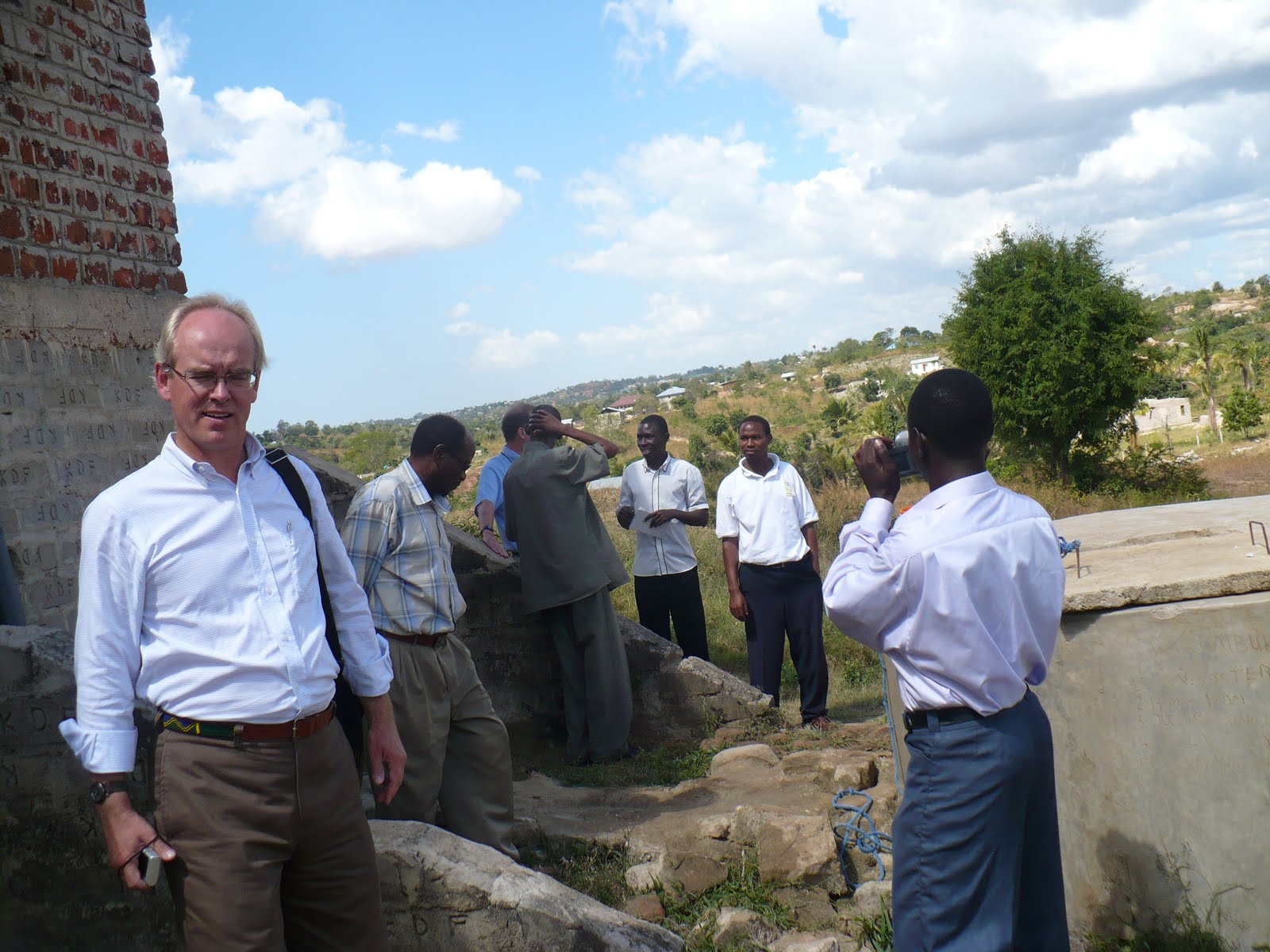
We had a good opportunity to meet and talk with the teachers. Mr. Alfred Mdima, third from the left on this photo, is the headmaster of the school. He gave us a tour of the school, which sits on farm land owned by his family.


Shulua Secondary School is a relatively new venture. We saw ongoing building and infrastructure projects. On the left is a well, just about completed.


Thinking about my experience at this school, I recall the motto of Makerere University, an institution I have visited twice. It says: "We Build for the Future."

Monday, January 17, 2011

LCCT Visit to the University of Dar es Salaam

On July 26 and 27, 2010, I was part of a four member delegation from the Lutheran Colleges Consortium for Tanzania that visited the University of Dar es Salaam (UDSM). We discussed with UDSM officials the current state and the future of the cooperation between LCCT and UDSM, a program that has lasted over twenty years. Under this program, many American students have studied at UDSM, and dozens of Tanzanians have visited LCCT institutions, advancing their graduate studies or enhancing their administrative skills and experience. Some of these Tanzanians are now prominent figures in government, education, and other sectors.

During our two days at UDSM, we met various officials. We had detailed discussions about key aspects of the LCCT program, such Swahili courses, the academic calender, student orientation, dormitory life, travel opportunities, safety, interaction between American and Tanzanian students, and the visiting scholar program.

We affirmed the value of the program and expressed the desire and determination to continue it, even in the face of challenges posed by the current world economic environment.

For me, this was another opportunity to reconnect with former colleagues, since I taught at the UDSM before going to St. Olaf College. Indeed, as we moved around the UDSM campus, we met a number of people who had been to the USA on the LCCT program.

People who have visited or studied at the UDSM will recognize the buildings on the left. The Arts and Social Sciences Tower is on the far left, and the Administration building is in the forefront, next to the parking lot. This is a main stop for "dala dala" minibuses going to Mwenge and Ubungo.


Here is the library, whose East Africana section contains the world's largest collection of Swahili manuscripts. This library also hold the Hans Cory collection, well known to anthropologists studying East Africa.


Here are two of the student halls of residence. On the left is Hall Two and on the right is Hall Five. As an undergraduate at UDSM, 1973-76, I stayed in Hall Five, on the seventh floor. I don't remember the room number, though. Visiting UDSM brings back fond memories of those days.


The UDSM has changed much since the days I studied there. A number of academic units and departments have grown and become faculties. The Faculty of Engineering has become the College of Engineering and Technology. The Faculty of Arts and Social Sciences has become the College of Arts and Social Sciences. The Faculty of Science is now the College of Natural and Applied Sciences. The Faculty of Education has become the Dar es Salaam University College of Education, a constituent college of UDSM, located miles away, in the city of Dar es Salaam. The UDSM has also established another constituent college, the Mkwawa University College of Education, several hundred miles up-country. The faculty of Medicine in down town Dar es Salaam has become the Muhimbili University of Health and Allied Sciences. The list goes on.

On the left is the University of Dar es Salaam Business School (UDBS). During my undergraduate days, it used to be the Department of Commerce and Management, housed in the Arts and Social Sciences Tower, not in its present location, which was a vast parking lot for University vehicles.