Friday, September 3, 2010

Children at the Tripod Media Exhibition, Dar es Salaam

As I wrote in a previous blog post, on June 24-25, I participated in an educational and careers fair in Dar es Salaam, Tanzania, organized by Tripod Media. I sought, among other things, to introduce Africonexion, my small consulting business, to Tanzanians.


One of the most exciting experiences I had was observing the children who came to the exhibition. These were mostly school children. It was pleasant to watch them as they moved from booth to booth, alone, in pairs, or in groups. Like children everywhere, they openly displayed their excitement and curiosity. They made Diamond Jubilee Hall come alive.


The booth of the Tanzania House of Talents was a popular spot for the children, especially when the live music was on.


Those who came to my booth enjoyed browsing through my books. They were particularly interested in CHANGAMOTO, my Swahili book, since they could read it.


It was touching to see how genuinely interested these children were in books. I kept thinking why, as the children grow up and become adults, they lose this attachment to books. Our society is failing these children.
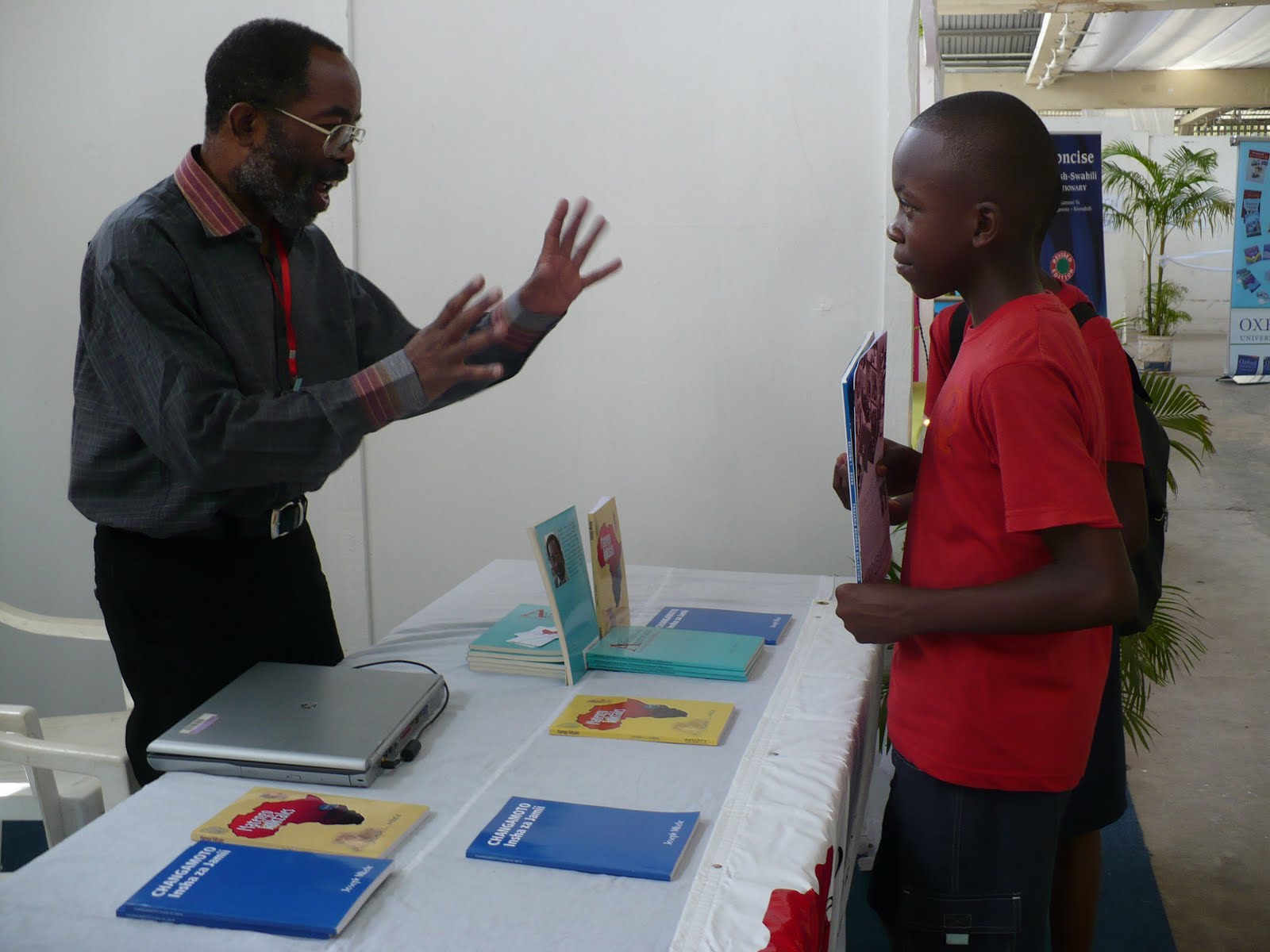


For the two days I participated in the exhibition, I talked with these children. I sought to inspire them, encouraging them to study hard. I told them to read widely, not just for the exams. They listened and I hope they will follow my advice.


One of the exhibitors was the Furniture Center. The children had a great time trying out the desks and chairs, pretending they were in a real classroom. When I saw this, I thought about the many schools in Tanzania which lack desks, chairs, books and other facilities. There is no valid reason for a country like Tanzania, rich as it is in resources, to have this problem.

The woman in a red head covering impressed me very much. She came with her son to the exhibition, and she asked me some questions. I wish all parents would do the same, accompanying their children to such educational events. It is good for the children and for the future of our country.

Saturday, August 28, 2010

The International Market Day, Faribault

Today was the International Market Day, in Faribault, Minnesota. This is an annual cultural festival organized by the Faribault Diversity Coalition.

It has been just a week since I returned to Minnesota from Tanzania, but as soon as I arrived, I got a reminder from Milo Larson, chair of the Coalition, about this important event. He wanted to be sure that I would be there, with my books.

You see him here helping set up my table. I believe in the work of the Coalition and will always support it.


As in the past, there were vendors of food, crafts, and other products. There were games, music, and informational resources.
There were Aztect dances, as in the past, attracting a large audience.


I met some new people today, such as this lady, who, it turns out, had studied, like me, at the University of Wisconsin-Madison.

What's more, she had taken an African storytelling course with Professor Harold Scheub, my dissertation advisor. It is, indeed, a small world.
This guy bought Africans and Americans and wanted to take a picture, with me holding Matengo Folktales.

Wednesday, August 25, 2010

My Arusha Readers

Visiting Arusha is always a treat. There are many people to meet, places to visit, and things to do. One of my joys is meeting my readers. There are quite a few: Americans, Europeans, Tanzanians, and others.

This summer, I spent several days in Arusha. I met my friend, Thomas Ratsim. He and J.M. Tours, the company he works for, have been steadfast fans of my Africans and Americans book. Many American travelers with J.M. Tours have heard about this book from Thomas.

The guys in the photo, taken in the Tarangire National Park during my Hemingway course, summer of 2008, were all with J.M. Tours. They had read Africans and Americans, and they regaled me with tales of how it helps them deal with tourists.

I visited the Arusha Times, which once carried an excerpt of my book. I met Linda, an American fan of the Africans and Americans book, whom I have known for some time, and who offers cultural orientation for foreigners in Arusha. Knowledgeable and experienced, she urged me to write a sequel. Thanks to readers like her, I am working on one.

I met Ingrid, a European teacher I did not know before. She works with school children and likes story telling. She was familiar with my Africans and Americans and Matengo Folktales, and she shared some interesting perspectives on both teaching children and cultural differences.

There are other places I would have liked to visit, and other people I would have liked to meet, if I had more time. One is the Peace House School, where I once gave a talk on the issues I raise in the Africans and Americans book. There, Africans and Americans work side by side. The director thought it would be a good idea for them to have on-going book discussions as a way of learning about their cultural differences.

I would have visited the office of the Global Service Corps, an American organization that sends volunteers to Tanzania and recommends Africans and Americans on its website. I have visited their office several times in the past and seen copies of the book there, for volunteers.

I wish to thank all my readers. Their continuing engagement with my work both inspires and sustains me.

Saturday, August 21, 2010

A Mosque Near Ground Zero

I have been here in my country, Tanzania, for the last two months. In the last few days, I have been following the controversy raging in the USA around the idea of building a mosque near Ground Zero, New York.

As a Tanzanian, I am saddened by the ignorance and Islamophobia that I see among many Americans. Here in Tanzania, we have mosques, churches and other places of worship everywhere. We know they have a right to be there. At the University of Dar es Salaam, for example, the mosque and the church are only a few yards apart, and everyone is comfortable with that situation.

As a Christian, I am used to hearing the muadhin calling Moslems to prayer, from every mosque, before sunrise and at different times during the day. These broadcasts are so much part of my life here in Tanzania that I miss them when I am in the USA, where I teach. The ignorance and prejudice I have mentioned exists also in so-called Islamic countries, and it would quickly rear its head if someone tried to build a church there.

I listened to President Barack Obama's speech in support of the idea of the mosque near Ground Zero, and I felt happy to hear the US Government defending a basic human right.

Saturday, July 31, 2010

Tripod Media Exhibition, Dar es Salaam

On June 24-25, I attended an educational and careers exhibition at the Diamond Jubilee Hall in Dar es Salaam. It was organized by Tripod Media, a company with a broad portfolio ranging from event promotion to video production. I do not remember how I came across the information about this event, but I saw it in the USA. I looked for more information and discovered Tripod Media and its founder, Dorothy Kipeja.

Tripod Media did a great job of organizing and advertizing the event. A number of companies and organizations participated. I got to know several. One of these was the Tanzania House of Talents (THT). I had heard about this organization but had not had the opportunity to meet them. I visited their booth, where they had live music and talked with their coordinator and got their brochure.

I saw school children who visited the the THT booth coming on stage to sing some songs. This was a pleasant thing to witness. It reminded me of a similar thing I witnessed on Tanzanian TV a few weeks earlier: children joined artist Mrisho Mpoto in singing his songs as he was performing in the street. What a remarkable display of synergy between artist and audience.

On this day, I also got to know the Proactive Employment Solutions, which describes itself as “a private labour recruitment agency based in Dar es Salaam.” I also got to know the Tanzania Schools Collection, an enterprise that seeks to list and profile educational institutions in Tanzania, with the intention of extending the coverage to East Africa and beyond.

I took this opportunity to present Africonexion, my cultural consulting company to the Tanzanian public. I had a booth where I displayed my books and talked with people about the work of this company and its vision for the future, which includes establishing itself in Tanzania, East Africa and elsewhere.

I was impressed by the diversity of the people who did come: different races, ages, and backgrounds. I hope that in the future more people will attend such events, including government officials, professionals, graduates, entrepreneurs and job seekers.

Friday, July 23, 2010

The Amazing Vuvuzela

As the 2010 World Cup drew near, South Africa got more and more in the limelight. I was in the USA, watching, as a debate emerged about the vuvuzela, a plastic horn blown by South African fans during soccer matches. Some people called for the banning of the vuvuzela from the World Cup, arguing that they could not stand the noise of the vuvuzela. I was amused, knowing that the Africans would not succumb to such demands. I recalled what I had written in my Africans and Americans book about how Africans differ from Americans in their attitude to loud music. Africans want their music loud.As it turned out, the vuvuzela not only reigned during the World Cup but it also spread to various parts of the world. I was in Tanzania during the World Cup, and I was not surprised to see that the vuvuzela had arrived in my country.People who had traveled to South Africa had brought the vuvuzela to Tanzania, and it was spreading rapidly. It features at soccer matches. I saw the vuvuzela on giant billboards around the country.
At Kimara in Dar es Salaam, I saw a small place called Vuvuzela Hair Salon. As an icon, the vuvuzela was quickly becoming a feature of popular culture, speech and jokes.During the World Cup, I read that people from Europe and elsewhere who traveled to South Africa for the World Cup took the vuvuzela home as a souvenir. Not everyone likes the vuvuzela, though. A few days ago, I read a report about efforts to ban the vuvuzela from a sporting event in New Zealand.

On July 11, I was in a bar called Sawai Grand, in the Sinza area of Dar es Salaam. It was packed with soccer fans. We were watching the final of the World Cup between Holland and Spain. That day, I saw the vuvuzela for the first time. The bar owner, a friend of mine, had brought it from South Africa. He handed that vuvuzela to me. I held it and blew it, again and again.
If you think the vuvuzela makes too much noise in a soccer stadium, wait until you hear one in a packed pub. Blowing that vuvuzela I felt its magic and knew that the vuvuzela was here to stay and conquer the world.

Tuesday, July 13, 2010

At Dar es Salaam University: Talking About Online Publishing

I have visited the University of Dar es Salaam several times this month and last month. On July 8, at the initiative of Professor Saida Othman, I met with a group of colleagues, in Professor Issa Shivji's office, to share my experience with online publishing. I enjoyed meeting these colleagues whom I have known from the early seventies, when I was an undergraduate at the University of Dar es Salaam.

I began by noting how technological advances are affecting and transforming various aspects of our lives, including business, academic work, and publishing. The internet is changing the way we do things, and traditional publishing is reeling under its impact, being forced to adapt or suffer. Costs and other factors render traditional publishing increasingly difficult, if not unsustainable.

I spoke about how I ventured into self-publishing, how I prepared and published my first book, Matengo Folktales, using print on demand technology. I talked about how, with the rapid evolution of online publishing, I explored alternative outlets and finally discovered lulu.com, where I have been publishing my latest books. I displayed two books I have published that way: Africans and Americans: Embracing Cultural Differences, and CHANGAMOTO: Insha za Jamii.

In an interactive manner, we covered many topics, including manuscript preparation, copyright, marketing, bookselling and royalties. We mentioned some pros and cons of self-publishing. The technology enables virtually everyone to publish their work, leading to concerns about lack of quality control. Many in the academic world worry about the absence of peer review of such publications.

We noted the irony that not all peer-reviewed books are better than self-published ones. I find it interesting that educators in colleges and universities recommend and use my self-published books.

We discussed how online publishing might work for University of Dar es Salaam journals and how local readers would access those journals. Certain types of online publishing and bookselling render books inaccessible to people without the means for online shopping.

I also mentioned the e-book phenomenon. I said that I have only recently entered the e-book world by turning my lulu.com books into e-books. I explained that the e-book requires an e-book reader, also known as an e reader. I find the idea of keeping hundreds, perhaps thousands, of books in a portable e-book reader attractive..We had a wonderful conversation for about two hours, exploring the opportunities, modalities, and challenges of online publishing. I write about these topics in my blogs and have also shared my ideas in CHANGAMOTO.