Showing posts with label Africonexion. Show all posts

Monday, May 8, 2017

Memories of the 2017 World Festival, Rochester


On April 29, as planned, the World Festival took place in Rochester, Minnesota. This was the culmination of weeks of planning by the Rochester International Association (RIA). I had featured the festival announcement on this blog.


My daughter Zawadi and I attended it, representing Tanzania and Africonexion: Cultural Consultants. We arrived at the festival venue at 9:45am, with enough time to set up our table and hang the Tanzanian flag on the wall. On the table we displayed my publications, including books such as Africans and Americans: Embracing Cultural Differences and Matengo Folktales.

Around 10:00am, festival visitors started arriving. We talked with those who came to our table about my work as a writer and cultural consultant. Several people recognized me from last year's festival, and I was humbled that they did.

After about thirty minutes, the flag ceremony started. This is part of the festival. It involves a procession of people from various countries carrying their national flags which they RIA owns. The RIA board had for the first time, acquired the Tanzanian flag, which I proudly carried in the procession.

For the rest of the day, we continued talking with people who visited our table and we handed out free xerox copies of my little article, "Chickens in the Bus," as well as information about Africonexion: Cultural Consultants.  We also took turns to walk around the exhibition areas, looking at various  displays and taking photos.


I passed by the table seen in the photo on the left. It was the Nigerian table and they cheerfully posed for this photo. Among the most memorable experiences were conversations my daughter and I had with a professor of Winona State University. As soon as she saw us, she remarked that she had bought my book last year. She said that she would like to bring her students to the festival in the future with an assignment: to interview people from four different countries in order to learn about global cultural diversity. I thought that was a brilliant idea.

Another memorable experince for us was talking with a lady who, after looking at my book, Africans and Americans: Embracing Cultural Differences. began telling of about her experiences in Japan. As an American, she said, she had made cultural blunders in communicating with the Japanese. We enjoyed the conversation, since her experiences resembled mine in the USA. It was rewarding to encounter someone who shared her personal stories so freely and with an arresting sense of humour.


Moving around, I visited a table where I saw a woman wearing hijab. When I approached the table, I realized I had seen this woman last year. On her table I saw Islamic books such as Muhammad Asad's The Message of the Qur'an, John L. Esposito's Who Speaks for Islam, and Wisdom for Life & The Afterlife: A Selection of Prophet Mohammad's Sayings, all of which I have in my collection.

I introduced myself, saying that I teach at St. Olaf College and one of my courses is "Muslim Women Writers," which I created to help counter prevailing ignorance about and misrepresentations of Islam and Muslims, especially Muslim women.

She, on her part, told me that she hosts the Faith Talk Show, and we agreed that it would be a good idea for me to appear on the show at some point in the future. Returning from the festival, I checked online and saw much information about this lady and her show, such this article. I am thinking it might be a good idea to invite her to speak in my Muslim Women Writer's class.

Throughout the festival there were performances by dance and musical groups from various countries. It was humbling to watch these performers as they generously shared their talents and traditions with all of us.

In addition to cultural items for sale, ranging from clothes and artifacts, to jewelry, and works of art, there were also foods from several countries.

The more I attend these festivals, the more I appreciate their value. As I watch the people attending the festival, volunteers, and vendors, and observe their countless conversations, I know that these festivals are a great way of connecting people. I am mindful of the fact that the people who attend the festival communicate with others around the world through email, social media, and so on, spreading the story of the festival around the world. I am doing that right now, with this blog post.

This was another very successful World Festival, a testament to enduring commitment of the RIA to bring people together.

Wednesday, May 13, 2015

Pursuing Peace, One Step at a Time


Today I went to Columbia Heights, Minnesota, to meet Mohamed Dini, a Minnesota resident originally from Somalia. A mutual friend, Abshir Daacad, who is a great fan of my work as a cultural mediator, had told Mohamed about me and my work, including my book, Africans and Americans: Embracing Cultural Differences.

When Abshir connected us, by phone, I learned that Mohamed had founded a non-profit organization called the Center for African Peace Research. During our meeting today, Mohamed told me more about his organization, and we talked about how I could contribute to its work, which is to promote peace, human rights and good governance in Africa.

I shared with him the work I do as a cultural consultant, emphasizing, for example, that unlike others who focus on conflict resolution, I concentrate on preventing conflicts by fostering understanding among people of different cultures, since many conflicts stem from cultural differences. Since he had read my book, he readily understood my perspective.

We explored many aspects of these goals, as well as strategies and  modalities of advancing them. We agreed we can work together fruitfully.

Talking with Mohamed, one gets the idea that he is a serious person with big dreams. In addition to the pursuit of peace in Africa, he is passionate about promoting a true and realistic image of Africa, irritated, like the rest of us Africans, by the stereotypes and negativity that characterize conventional representations of our continent.

For more information, please visit the Center for African Peace Research and Africonexion: Cultural Consultants.

Thursday, March 19, 2015

Troubles Over Loud Music in Brooklyn Park, Minnesota

For quite a while, the City of Brooklyn Park, Minnesota, has been in the news over loud music in its parks. The Brooklyn Park City Council banned loud music from all but one park, following complaints by residents living near those parks. The Minneapolis Star Tribune, for example, published this report about the issue.

The ban has prompted much opposition from those who feel victimized by it. African residents of Brooklyn Park have been quite vocal in this regard, as reported here.

I have been following the issue on Facebook as well, where the Africans have been voicing their views and sentiments, generally opposing the ban, describing it as unilateral, discriminatory, and insensitive to the cultural values of the immigrants. The photo above, from Abdullah Kiatamba's Facebook page, shows a meeting between City authorities and residents.

I am a cultural consultant, specializing in the cultural issues Africans and Americans face when they interact. Several years ago, I was invited to Faribault, another Minnesota city, to participate in a dialogue about problems that were brewing between long time business owners and Somali immigrants. The core issue was the habit of Somali men congregating in the downtown area, blocking sidewalks and, according to the business owners, scaring away customers. I discussed the issue as stemming from cultural differences, to the satisfaction of all.

Reading about what is happening in Brooklyn Park, I keep thinking about what I wrote in my book Africans and Americans: Embracing Cultural Differences whose opening paragraph mentions loud music:

This booklet deals with differences between African and American culture. I noted these differences during my graduate studies at the University of Wisconsin-Madison, 1980-86. I used to spend much time with fellow African students joking about American ways. We wondered why, for example, the police often arrived at parties, to report complaints by neighbours that the music was too loud. What was the purpose of a party, we wondered, if not to have a good time, and how could anyone have a good time if the music was not loud? Compared to African parties, American parties seemed like funerals. (p. 1)

As the world becomes increasingly interconnected, with people moving and settling everywhere, every community must find ways to deal with changing realities, including cultural differences. Loud music is only one issue, but there are many others, such as food, dress, religion, modes of communication and behavior.

There is no escape from these realities. All we can do is educate ourselves, learning from and about one another, understanding our differences and learning to accommodate them in our lives, so that we can live and work together in harmony.
 

Saturday, October 19, 2013

Reflections on The 2013 Twin Cities Book Festival

The Twin Cities Book Festival on October 12 in St. Paul, Minnesota, was another memorable, successful event. In order to be on time for the opening of the Festival, I left early, at 8:00am, arriving at 9:00am. As I was setting up my table, many other exhibitors were doing the same.


I had paid $80 for a half table, and was assigned table number 12. I had registered my exhibition under the name of Africonexion, a little company I own and run, which publishes my books and coordinates my seminars, workshops, and  presentations. The focus is the challenges and opportunities presented by cultural diversity.


As usual, people started arriving early, and when the doors opened, the exhibition hall became a hive of activity. It was heartwarming to observe so many people moving from table to table, talking with authors, booksellers, and publishers, browsing through books and buying books. 


I hear much about the declining fortunes of the book and the book industry as we know it, but being in an event like this festival makes you forget completely that there is such a decline. The number of publishers alone, and the many many titles on display, is enough to give you second thoughts.


Above all, none of these people seemed despondent. On the contrary, they exuded good cheer and optimism. The large number of readers and book buyers underlined the point, at least for me, that the book is here to stay.

Because I was at my table the whole time, I did not get the opportunity to hear the guest writers and observe other programs which were part of the Festival. But this could not be avoided, and it did not diminish the fullness of my satisfaction.


I met and had conversations with a good number of people, and was pleased to see them browse though my books, giving me an opportunity to talk about my work. I cannot express well enough how humbled I was when the people who bought my books asked that I sign them.

It was another very memorable Festival, thanks to the hard work, diligence, and commitment, of Rain Taxi and the many volunteers who worked hard and cheerfully, throughout the day answering questions and helping anyone who needed help. I look forward the 2014 Festival.

Friday, August 2, 2013

Afrifest Twin Cities is Here Again, August 10

Afrifest 2013 is just around the corner, August 10. A pan-African educational and cultural festival designed to educate and connect people, Afrifest has been around for seven years now, its crowning achievement being an annual festival showcasing the history, politics, arts and culture of people of African descent.

Over the years, Afrifest has featured musical performances, fashion shows, vendors and educational displays. There are a lot of activities and games for children.

I have always been touched to see children meet and play with children from different countries and cultures. Afrifest is an opporttunity for them to cultivate a pan-African consciousness at an early age.

In these seven years, through my involvement with Afrifest, I have met and learned about many many people: Africans, African-Americans and others. I cherish the connections I have made.

Every individual, whether from Africa, the Caribbean or the USA or elsewhere has unique experiences and perspective. Talking to each of them is like going through a valuable educational experience. Equally important is the opportunities I have to share my own experiences and perspective as an African, a writer, educator and cultural consultant.

On the left is the booth of Liberation Clothing & Gifts from Afrifest 2012. I bought a lovely Bob Marley T-shirt here.

From the beginning, I have involved my own children in Afrifest, because I know the social and educational value of such involvement. They get to meet different people and see the displays representing different countries and cultures.

I always set up a table, as one of the vendors, on which I display my books and other educational materials. My children enjoy assisting me. They are able to talk to people about my writings and my work as an educator and cultural consultant. They are able to speak to the media on my behalf, as can be seen in the photo on the left.

As a member of the Afrifest Foundation board, I wish to invite everyone  to Afrifest 2013. Just to give you a sense of the diversity of Afrifest offerings this year, there will be a soccer tournament, health and wellness fair, vendors, food, and games for children. As a parent, who firmly believes in the value of events and programs such as Afrifest, I encourage all parents to bring their children to Afrifest 2013. For more information, visit the Afrifest website

Friday, March 11, 2011

Minnesota Black Pages 2010-11

The Minnesota Black Pages 2010-11, a rich source of information on businesses, products, and services pertaining especially to people of African descent, is now available. The current edition focuses on the housing crisis. In line with my abiding interest in cultural issues, I contributed an article titled "Housing as a Cultural Phenomenon", pp. 29-30.

Readers of my Africans and Americans: Embracing Cultural Differences, will remember that housing is one of the issues I talk about in that book. For the Minnesota Black Pages 2010-11, I went somewhat beyond what I wrote in the book.

The Minnesota Black Pages 2010-11 also carries advertisements, and you can read about Africonexion, my consulting company, on page 28. On page 41 you can read what the Minnesota Black Pages team wrote about my Africans Americans book. Enjoy the Minnesota Black Pages 2010-11.

Tuesday, October 12, 2010

The Twin Cities Book Festival Approaches

The Twin Cities Book Festival is just around the corner, October 16. I look forward to being there, as usual, meeting writers, publishers, editors, and book lovers. It has always been a treat.

As an exhibitor, using the Africonexion label, I have all my books ready. I look forward to talking with people about my experiences as an educator, writer, and cultural consultant. I will write about it all on this blog, as I have always done. For more information about the Festival, read here.

Friday, September 3, 2010

Children at the Tripod Media Exhibition, Dar es Salaam

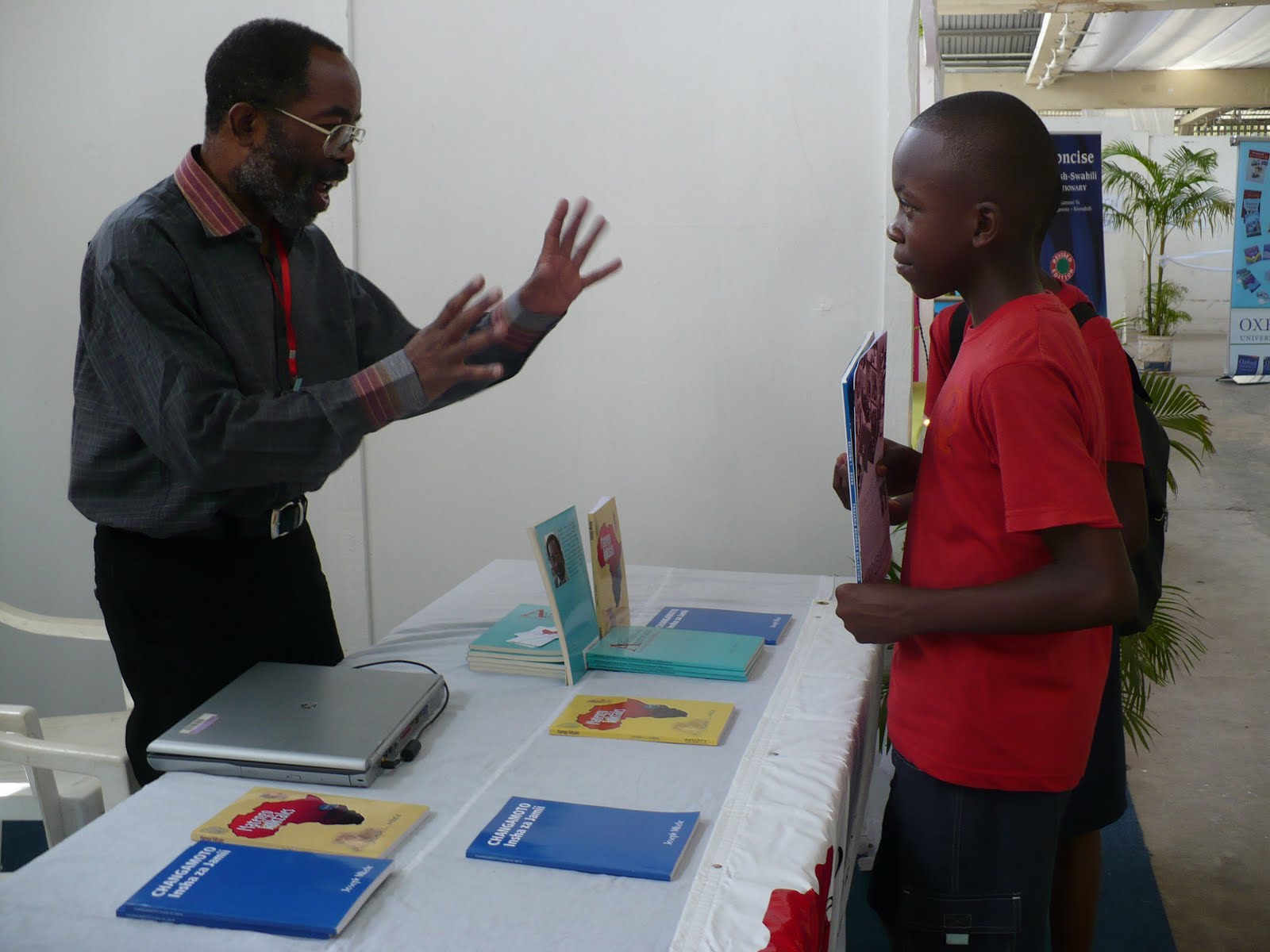
As I wrote in a previous blog post, on June 24-25, I participated in an educational and careers fair in Dar es Salaam, Tanzania, organized by Tripod Media. I sought, among other things, to introduce Africonexion, my small consulting business, to Tanzanians.


One of the most exciting experiences I had was observing the children who came to the exhibition. These were mostly school children. It was pleasant to watch them as they moved from booth to booth, alone, in pairs, or in groups. Like children everywhere, they openly displayed their excitement and curiosity. They made Diamond Jubilee Hall come alive.


The booth of the Tanzania House of Talents was a popular spot for the children, especially when the live music was on.


Those who came to my booth enjoyed browsing through my books. They were particularly interested in CHANGAMOTO, my Swahili book, since they could read it.


It was touching to see how genuinely interested these children were in books. I kept thinking why, as the children grow up and become adults, they lose this attachment to books. Our society is failing these children.


For the two days I participated in the exhibition, I talked with these children. I sought to inspire them, encouraging them to study hard. I told them to read widely, not just for the exams. They listened and I hope they will follow my advice.


One of the exhibitors was the Furniture Center. The children had a great time trying out the desks and chairs, pretending they were in a real classroom. When I saw this, I thought about the many schools in Tanzania which lack desks, chairs, books and other facilities. There is no valid reason for a country like Tanzania, rich as it is in resources, to have this problem.

The woman in a red head covering impressed me very much. She came with her son to the exhibition, and she asked me some questions. I wish all parents would do the same, accompanying their children to such educational events. It is good for the children and for the future of our country.

Saturday, June 26, 2010

Africonexion Meets Kanga Kabisa


Marianne NilssonWallin and I got connected on Facebook. Based in Zanzibar and Minnesota respectively, we corresponded for about a year. Then, on June 17, 2010, we met for the first time, in Dar es Salaam.

A Swede, Marianne came to Tanzania for the first time in 1969, and she has been engaged with Africa ever since. She runs the Kanga Kabisa company, which makes products out of the famous khanga fabrics produced in Tanzania.

Kanga Kabisa is a business with a social mission. It strives to use local materials and resources to make quality products. Marianne believes that Africa can create high quality products which should be promoted, for the benefit of both Africans and the world. Marriane believes this is needed in order to promote a better awareness of Africa among Europeans and other foreigners.

I was happy to learn about the Kanga Kabisa philosophy. I run africonexion, a small consulting business which promote awareness of cultural differences and strategies for coping with and leveraging them. Africonexion seeks to empower people, giving them the tools for managing their lives and work in this world which is getting more and more interconnected. Like Kanga Kabisa, Africonexion is a business with a social mission: to make the world a better place, with a focus on people and sustainability.

Marianne and I love books. We discovered this when we got connected on Facebook. We shared information about publishers, books and book fairs and discovered that we have mutual friends and colleagues in this field. Marianne has read some of my books, likes them, and is keen to promote them.

Thursday, April 1, 2010

"Minnesota Black Pages" Online

The "Minnesota Black Pages" is now available online. As an invited contributor, I wrote about my consultancy work (page 34), and about food and culture (page 106-108). The editors also wrote about my Africans and Americans book, on page 47. Read the "Minnesota Black Pages" here.