Showing posts with label Tanzania. Show all posts

Monday, August 14, 2017

Roma's "Zimbabwe" Song


Roma, a Tanzanian composer and singer, has become a household name in Tanzania, albeit controversial, on account of his compositions. His latest song, "Zimbabwe," has just been released to much acclaim, but also reservations. It is a charged piece that is bound to raise sentiments and maybe ruffle a few feathers.

"Zimbabwe," is a music video that brings up seemingly disconnected and random images and references incorporating ideas, sentiments, and pleas. Clad in flowing robes, like a prophet, Roma traverses an expansive landscape proclaiming his message, which sounds like an apocalypse. I think of Yeats's vision--in "The Second Coming"--of a rough beast slouching towards Bethlehem to be born, but Roma's vision is not entirely dark and ominous.

The plight of prophets is often uncertain and Roma's is no exception. He has experienced rejection, censure and even kidnapping, which is a key theme, if not the impetus, of his "Zimbabwe" song. A prophet can be rejected, becoming a voice crying in the wilderness. In this video, Roma appears in the wilderness much of the time, but he has a sizable following, heading with him towards the distant horizon beyond which, presumably, Zimbabwe lies.

I have stated that this song pulls together seemingly disparate and random ideas, sentiments, and references, but there is method in the madness. Running through the song is a mood, not of celebration or joy, but sadness, which is sustained by the repetitive beat of soulful sounds. The sadness and somber feeling is conveyed by references to kidnappers and their evil deeds, and is reflected in the faces of the people and accentuated by the image of a crying child. The randomness of images and references can also be read as a mirror or an oblique but caustic commentary on, or indictment of, the political system of today's Tanzania, which critics berate for what they consider its erratic and impulsive modus operandi.

Roma's song exemplifies Cleanth Brook's idea that the language of poetry is the language of paradox. The very image of Zimbabwe is paradoxical. Given the global, media-driven image of Zimbabwe as dismal and dysfunctional, Roma's song appears to present Zimbabwe as the Promised Land. We see Roma leading a multitude across the wilderness, in an exodus towards this Promised Land, in the manner of Moses and Joshua in the Old Testament.

On the other hand, the image of Zimbabwe in this song can also be interpreted as bitterly ironic, with its suggestion that one is much better off being in Zimbabwe than in Tanzania. Although this might spark contention among Tanzanians, my interpretation shows how Roma turns the negative image of Zimbabwe on its head, essentially signifying upon the media-driven stereotype I have mentioned. Roma is a kind of trickster figure, driven to upsetting conventional perceptions and exposing the ambiguity of things.

The juxtaposition of Zimbabwe and Tanzania in the song can be further deconstructed. We can say that the song implies that Tanzania is deteriorating so fast that we had better escape to Zimbabwe before it is too late. This interpretation, needless to say, is not likely to please many Tanzanians. But I am not claiming that this is what the poem says. My reading of it might, in fact, be contested by other readings, which is the norm in the field of literary interpretation.

If we view the notion of paradox in the broad terms outlined by Brooks, Roma's song is packed with paradoxes. These manifest themselves not only in the image of Zimbabwe but in other ways as well, such as the image of the old African lady playing the piano. I doubt if there is any Tanzanian who associates old African ladies with piano playing. Yet, if we take a historical and broad view, we find that African women, especially old women, have been prime carriers of our artistic heritage--storytelling, music, and song. Achebe's Things Fall Apart, for example, portrays a mother who tells stories to her children. In East Africa, there is a long tradition of female poets and singers, such as Mwana Kupona, Siti binti Saad, Bi Kidude and Shakila Said. The image of Roma's old woman playing the piano is not as far-fetched as it appears.

The discourse of Rama's song is propelled as well by both significant hints and direct statements. Among the hints are those relating to kidnapping and the experience of captivity. Among the direct statements is the challenge to the unnamed authority figures to lay down their guns and engage in debate propelled by reasons. In the context of the growing belief that Tanzania's political system is becoming dictatorial, the song's statement is a direct indictment of that reality.

In generic terms, "Zimbabwe" can be read as the continuation of the tradition of African prison poetry which includes poems such as Liongo Fumo's "Wimbo wa Saada," and Abdilatif Abdalla's Sauti ya Dhiki, from the Swahili tradition, as well as Dennis Brutus's Letters to Martha and A Simple Lust.

Following Brooks's warning against what he called "the heresy of paraphrase," I will say that Roma's song, like any work of literature, speaks for itself. No interpretation will adequately capture its complexity, nuances and its capacity to generate meanings, which is limitless. For me, however, this song, unsettling as it is, remains timely, relevant, and indispensable. It is a mix of disturbing sentiments and images made palatable, nevertheless, by melodious and irresistible music that will endure in people's memory for a long time. I feel it has the makings of a classic.

Tuesday, January 10, 2017

A Gift From Ramble Pictures Honouring Hemingway

A few days ago, I received a special gift from Ramble Pictures, a film production company based in Minneapolis, Minnesota. It is a framed picture announcing a documentary titled Papa's Shadow, which deals with Hemingway in East Africa. Much of the documentary is a conversation between Patrick Hemingway and me about Hemingway's African experiences as reflected in his writings, as well as his ideas about writing, culture, and life in general.

The picture features Ernest Hemingway, Patrick Hemingway and me, as well as Mount Kilimanjaro, the vast plain below it, and a plane in the air. This scenery magnificently evokes Hemingway's famous short story, "The Snows of Kilimanjaro."

I am humbled to be featured alongside Ernest Hemingway, one of the greatest writers in the English language, as well as Patrick Hemingway, his son and only remaining child, who knows my country and East Africa very well, having lived there for twenty five years, and who has been my mentor in my efforts to study Ernest Hemingway.

I am equally humbled that Patrick is also a great admirer of my work, such as my book, Africans and Americans: Embracing Cultural Differences. In Papa's Shadow, Patrick refers to it and he is seen reading a passage from it, in Swahili and my English translation.

Papa's Shadow focuses on a dimension of Ernest Hemingway that is not well known: his life long fascination with Africa. In the course of studying Hemingway, I realized this deficiency and decided to create a course, Hemingway in East Africa, which inspired Jimmy Gildea, one of the students, to create Papa's Shadow. I highly recommend this documentary. To order it, contact Ramble Pictures. email: info@ramblepictures.com, telephone: (952) 426-5809.

Sunday, December 4, 2016

Waiting to Meet Gustavus Adolphus College Students

I have received an invitation from Professor Barbara Zust of Gustavus Adolphus College to speak with students she is preparing to take to Tanzania on a study abroad program. She has informed me that the group will meet on January 2 and 3 at the Mount Olivet Retreat Center for their pre-trip orientation. I responded right away that I will join them on January 2.

Professor Zust has led this program again and again and has always invited me to talk with her students about cultural issues. Before our meetings, she has the students read my book, Africans and Americans: Embracing Cultural Differences.


I always look forward to these opportunities to talk with Americans about what they should expect when they go to Africa or when they interact with Africans in the U.S.A. This is the work I do under the auspices of Africonexion.com

I have always been touched and humbled by what the students say when they are in Tanzania and after their return to the U.S. A. They admire and appreciate the hospitality of the Tanzanians, and they note how their experiences in Tanzania accord with what I say in my book and in our orientation meetings about cultural differences. As I reflect on all this, I tell myself: what a great way to foster mutual understanding in our world, which is increasingly becoming a global village.

Saturday, September 24, 2016

David, Son of Jackie Robinson, at the University of Minnesota

On Thursday, September 22, I went to the University of Minnesota in Minneapolis, to hear David Robinson, a coffee farmer in Tanzania. He is the last of the children of Jackie Robinson, the legendary African-American baseball player and indomitable civil rights activist of the forties and fifties, who passed away in 1972.

Visiting Ethiopia as a teenager, David fell in love with Africa and, in the early eighties, decided to settle in a village called Bara, tucked away in the Mbozi district of southwestern Tanzania. He introduced himself to the curious village elders, telling them that he was an African from somewhere in Africa--even though he didn't know where--and that he had been taken from the continent and was lost for several centuries in slavery in far away America. Now he had decided to come back home, and he wanted land to establish a farm.

The villagers showed him a large area and he set about establishing a coffee farm, creating, together with fellow villagers, a cooperative society called Sweet Unity Farms. David talked about the activities of the cooperative farm, the challenges, and the lessons gained along the way.

He talked about not only the work on the farms, but also the business side of things--which is rife with challenges. This includes marketing and selling Sweet Unity Farms coffee around the world. Though located in a rural place, Sweet Unity Farms seeks ways to establish itself in a global market dominated by big multinational corporations.

The photo on the left features David, Limi Simbakalia, a Tanzanian student at St. Olaf College,  where I teach, and me.

There is much information online about David Robinson and Sweet Unity Farms, such as this wonderful article. I have been reading about David Robinson for some years and, in the process, a little about Jackie Robinson. After meeting David, however, I have been learning more about his father and gaining a good sense of the stature and significance of this legendary sportsman and civil rights activist.

Friday, May 20, 2016

A Talk With Patrick Hemingway

I called Patrick Hemingway yesterday evening at 8:22 pm, to let him know that I will soon be going to the John F. Kennedy Library in Boston, to visit the Hemingway collection. As usual, his wife Carol picked up the phone, and the moment she realized I was the caller, she got Patrick on the line.

As soon as we had greeted each other, Patrick mentioned his impending birthday and remarked, light-heartedly, that he was not getting any younger. I told him that his birthday reminds me of my visit, years ago, to Kansas City, where he was born, and the places I visited in that city, which are associated with Hemingway: the premises of the Kansas City Star, the Hemingway home, and the railway station. I forgot to tell Patrick that I also visited the Muehlebach Hotel.

I gave him an update of my Hemingway pursuits--that I had been encountering and reading his prefaces to the new editions of Hemingway's books prepared by Sean Hemingway. I also introduced the subject of the work Sandra Spanier is doing in producing volumes of Hemingway's letters. We agreed that Sandra's work is very valuable.

We talked about developments in Tanzania and sub-Saharan Africa in general, and Patrick reiterated his concern about the future, wondering whether our countries will be able to sustain their urban populations. He is concerned about the kind of urban growth that is taking place, and the increasing burden on the rural people who are supposed to feed the urban populations.

Patrick's concerns about the negative developments taking place in Africa remind me of Ernest Hemingway, who also bemoaned the disappearance of the balanced life of the African people he knew, such as the Maasai. Patrick emphasized again and again that he did not know the solutions to the encroaching problems he was so aware of.

I told Patrick that I called him to let him know about my plans to visit the Hemingway collection at the John F. Kennedy Library, in mid-June, and he repeated his previous pledge to introduce me to the library staff. One thing I always note in my conversations with him is that despite his age--turning 88 this June--his memory is incredibly sharp. He told me that this was a good time to visit the John F. Kennedy Library because there is an exhibit in progress which will continue for some months. He said I should make sure to also see the lion on the floor.

I didn't know anything about this "lion on the floor," but just now, while writing this blog post, I have checked online and read about it. To my surprise, this is the famous "Miss Mary's lion" we read about in Ernest Hemingway's Under Kilimanjaro. This is truly exciting, since I didn't know that this lion had been transported to the U.S.A. I also checked online just now and found information about the exhibit. This is going to be a truly remarkable experience for me.

I also mentioned to Patrick my desire to visit the Hemingway home in Key West, but he said I should think more about visiting Cuba. Patrick and I have talked about Cuba before, with a focus on the Finca Vigia, Ernest Hemingway's home. He noted that with the current state of relations between Cuba and the U.S.A., this should be easier than in the past, although such visits for researchers were allowed.

We talked for 25 minutes, which is probably the shortest conversation we have had, but it was valuable and memorable. (The photo above was taken at Patrick and Carol's home in Craig, Montana, on 27 April, 2013)

Wednesday, December 30, 2015

A Memorable Meeting in Minnesota

Today was a special day. I had a memorable meeting with Dr. Barbara Poole Galyen, a friend of many years, who is based in California, but has been visiting relatives in Minnesota, a short drive from Northfield, where I live.

Barbara and I met for the first time in 1995, when she came to Tanzania as a volunteer on my research project on epic folklore of Northern Tanzania, sponsored by Earthwatch. We worked on Ukerewe Island in Lake Victoria.

Barbara told me that time, and has kept telling me, that that experience sparked her interest in Africa and launched her on her subsequent professional life. She went to Kenya to work for the United States International University, and later started a consulting company dealing with cultural issues in the global context. She has traveled the world and made many connections.

We were delighted to meet today, having met for the last time in 1997 in Kenya. We shared stories about our time in Ukerewe, current politics, and a new course I will be teaching in the spring--"Muslim Women Writers." I signed for her a copy of my book, Africans and Americans: Embracing Cultural Differences, which relates to our mutual interests as cultural consultants.

Here is what Barbara herself wrote today on her facebook page about our meeting:

I enjoyed a wonderful visit with Dr. Joseph Mbele who was the one who originally introduced me to Africa in 1995 on an "Earthwatch" adventure. I give him credit for changing my life completely after I moved to Kenya as a result of our fascinating studies on a remote island in Lake Victoria, TZ. Born in Tanzania, Dr. Mbele is currently a professor at St. Olaf College in MN where he continues to work on special projects around the world! He's inspiring me again to get more involved in heart-felt projects globally.

Saturday, October 3, 2015

If You Like My Writing, Please Support "Papa's Shadow"

I know there are thousands of readers of  my writings out there, thousands who have read my book, Africans and Americans: Embracing Cultural Differences. A number of these have told me how much they like this book.

One of them is Patrick Hemingway, the only remaining child of Ernest Hemingway. Having lived for much of his adult life--over twenty years--in my country, Tanganyika (later Tanzania), he knows exactly what I am saying in this book, which he calls "a tool of survival."

I wish to let my dear readers know that I have joined hands with Patrick Hemingway to share our reflections on his famous father. We appear in a documentary film by Jimmy Gildea titled Papa's Shadow, discussing Ernest Hemingway's life, travels, writings, and thoughts, especially those connected with his African experiences in 1933-34 and 1953-54.

If you have read my Africans and Americans book, you will enjoy hearing Patrick Hemingway mentioning it and reading from it as he and I talk about Hemingway's appreciation of different cultures.

Papa's Shadow is a unique documentary. It will change the way people view Ernest Hemingway. I saw this a few weeks ago at its premiere screening in Minnetonka, a suburb of Minneapolis.

The documentary is completed, but it will only be released after certain costs are  met. There is a fund drive going on, scheduled to end just over a week from now. As a contributor to this effort, I am joining hands with Ramble Pictures, the company that Jimmy founded, to solicit the remaining contributions. There are special incentives attached to the contributions, including a signed copy of my Africans and Americans book, for contributions over 200 dollars.

Read more about Papa's Shadow, and, if you can, make your contribution at this Kickstarter site.


Saturday, August 15, 2015

International Festival Faribault, August 22

August 22, 2015, the International Festival Faribault will take place in Faribault, Minnesota. This will be the 10th year of the festival, which brings together the various nations represented in Faribault, to share their cultures and foster mutual understanding.

I have already signed up as a participant. I will have a table where I will display my books and talk with people about my work as an educator, writer, and cultural consultant. I consider events of this kind an extension of my classroom, whose spirit of give-and-take is highly rewarding. What I learn on these occasions enriches my teaching in various ways.

The International Festival Faribault is an opportunity to meet people from different parts of the world and to see the cultural items and other things they display, watch their performances, and sample their foods. Year in and year out, I have found the conversations with different people enlightening.

This year, I will also talk about a documentary film on Ernest Hemingway titled Papa's Shadow, produced by Jimmy Gildea, a 2014 alumnus of St. Olaf College, who was one of the students who came to Tanzania in 2013 on my Hemingway in East Africa course. The documentary features me in conversation with Patrick Hemingway, the only remaining child of Ernest Hemingway, born in 1928. We are talking about Hemingway's life, travels, and writings, especially those concerning East Africa.

Hemingway was an avid world traveler, who was genuinely interested in, and respectful of, other cultures. As an African, I like sharing my great admiration for Hemingway's lifelong fascination with Africa, an aspect that is not well acknowledged by readers and scholars alike. Indeed, Hemingway exemplified the kind of spirit the International Festival Faribault stands for.

Wednesday, May 6, 2015

I Got My National Flag Today

Today, I got the flag of my country, Tanzania. Its colours bear symbolic significance. The green represents our beautiful land, the yellow our minerals. The black stands for the people, while the blue represents our country's water bodies, notably the Indian Ocean, lakes, and rivers.

The immediate impulse for my buying the flag has been my experience in festivals where participants represent their countries bearing their national flags. I felt bad being in those situations without my national flag.


One of the most unforgettable, if not embarrassing, experiences was the International Faribault Festival held on August 23, 2014. I watched from my vendor table while other Festival participants stood on the main stage bearing their national flags, said a few words about their countries, and then paraded in single file, to place their flags in the middle of the open space where they fluttered the whole day. I vowed to get my own flag.


Like most people, I love my country, but I was also taught, as I was growing up, to respect all countries. We desired to be friends with any country on the basis of mutual respect, and we would not allow anyone, even our friends, to choose our enemies for us. Such was the blend of nationalism and internationalism our first president, Julius Nyerere, inculcated in us, which has guided our country since the earliest days.

Monday, January 5, 2015

A Meeting With Students from Gustavus Adolphus College

Today I went to the Mount Olivet Conference & Retreat Center in the Farmington area of Minnesota, to speak with students from Gustavus Adolphus College who are going to Tanzania this week on a study abroad program. I had been invited by Professor Barbara Zust to talk with them as part of their pre-departure orientation, and, as in the past, our conversation centered on my book, Africans and Americans: Embracing Cultural Differences. As has always been the case, the students came having read the book and eager to learn more.

After the formal conversation, which lasted from 10am to 12 noon, some students brought me copies of my book for signing. Then we had lunch, during which, of course, we continued conversing in small groups. I shared a table with Professor Zust and Pastor Todd Mattson--co-leader of the trip--and several students. When we finished our lunch, I signed some more copies of the book. We then said goodbye, and I hit the road back to Northfield, where I live.

This was another memorable meeting which involved much reflection and sharing of cultural issues and perspectives, both African and American. I am delighted to be involved in the students' quest for greater understanding and appreciation of a culture different from their own.

Tuesday, October 9, 2012

St. Olaf Off-campus Studies Open House

Today, here at St. Olaf College, we held another off-campus studies open house. This is an event to promote our off-campus and international programs. We offer students information about these programs. I am the advisor for the ACM Botswana program, the ACM Tanzania program, and the Lutheran Colleges Consortium for Tanzania (LCCT) program.


St. Olaf College runs, or participates in, many programs around the world: from Australia to Costa Rica, from Florence in Italy to South Africa. Some of these programs are month-long, others semester-long, and some year-long. Today we showcased semester and year-long programs.


St. Olaf College is well known for its study abroad programs, among other things. Many students come to St. Olaf because of the prospect of going to study abroad.


This was another day of meeting students and also other program advisors. Scott Ozaroski and Hannah Whitehead from the ACM office in Chicago participated in the events today and since their table was adjacent to mine, we had some time to chat. Scott kindly took the photo of me and the two students seen at the top of this page.

Tuesday, September 4, 2012

More Good News About My "Africans and Americans" Book

I wrote Africans and Americans: Embracing Cultural Differences to facilitate my work of advising American students going to study in Africa. I was painfully aware that there was no book I could rely on for the kind of orientation I wanted for these students. I therefore decided to write my own book.

I am grateful that other people like this book. Lately, Elizabeth M. Cannon and Carmen Heider, professors at the University of Wisconsin-Oshkosh, have written about their experience of using this book. In a recently published article, they discuss their experience of leading a study abroad program in Tanzania, including the challenges of motivating students and providing them socio-cultural orientation. They led the program several times, learning from each experience in order to improve the program. Here is what they did during the third year:

We also thought carefully about how to design our on-site class sessions to reflect our commitment to active, student-centered learning, and provide general guidance to our students. We decided to focus these classes on Mbele’s Africans and Americans: Embracing Cultural Differences, one of our readings from 2008, because this Tanzanian author challenges stereotypes through the presentation of his cultural experiences. Before we left the United States, we divided students into four groups and assigned each a section of this text on which they would lead one of four on-site class sessions. On-site discussions focused on comparisons between Mbele’s views of Tanzanian life and students’ interactions with the people they met and the places they visited. Frustration was replaced with excited conversations. These classes shifted from tense obligations where learning was stifled to an exciting component of the trip where insights flourished (p. 68).

I am happy and grateful that the book is such a helpful resource for others.

Sunday, September 19, 2010

A Meeting of the Lutheran Colleges Consortium for Tanzania

On September 18, the advisory board of the Lutheran Colleges Consortium for Tanzania (LCCT) met at St. Olaf College. Consisting of Concordia College, Luther College, Pacific Lutheran University, and St. Olaf College, the LCCT runs an exchange program with the University of Dar es Salaam (UDSM).


Students from these colleges go to study in Tanzania for a semester, and UDSM faculty and administrators spend about four months on LCCT campuses, for research and other professional activities. The program started in the mid-eighties and has involved dozens of Americans and Tanzanians.


For many years, the LCCT program was unique among the American programs linked to the UDSM, because it was based on reciprocity, a feature that was noted and much appreciated by all.


The LCCT board consists of people who have an interest in study abroad programs, an interest in Tanzania or Africa as such. We have done research in Africa, taught or written about Africa, led students on study programs in Africa, hosted or mentored African visitors and students on the LCCT campuses. In various ways, we contribute to African studies.

Each of the LCCT institutions takes turns administering the program. At the September 18 meeting, Luther College handed over the administration of the LCCT to St. Olaf College.


As a Tanzanian, I am pleased that many Tanzanians in academic and leadership positions have benefited from this program. Working on the board is a labour of love. We all value the work we do, knowing how important it is to the education of our students and to the UDSM. I wonder if I am a naive idealist, but I believe programs like the LCCT help build a better world.

Tuesday, September 14, 2010

Lushoto: A Tanzanian Town

I wish I could write a fitting tribute to Lushoto, a small town nestled in the Usambara mountains of northeastern Tanzania. Though small, Lushoto is quite well known, in Tanzania and beyond.


I have visited this town several times, mostly to research local folklore about Osale Otanga and Paulo Hamisi, famous outlaws who operated in this area in the 1950s. Still, I like this town so much that I would come for any other reason.


This region attracts tourists from around the world, and there are several programs here dealing with tourism.


Downtown Lushoto is a hub of activity. The market is here, the bus stop, stores, and other businesses.


There are many places to stay, and new ones keep coming up. This year, I stayed in this hotel, near the District Office.


This church, just across the road from the police station, has become for me a kind of icon.


A walk in downtown Lushoto is refreshing, because of the cool climate and minimal traffic.


Whenever I am here, I seek vantage points from which to enjoy a panoramic view, the rich blend of trees of different kinds, houses, hills, the cloud-laden skies. I enjoy the peace and quiet, and wonder if anyone can ever tire of visiting this place.

Friday, September 3, 2010

Children at the Tripod Media Exhibition, Dar es Salaam

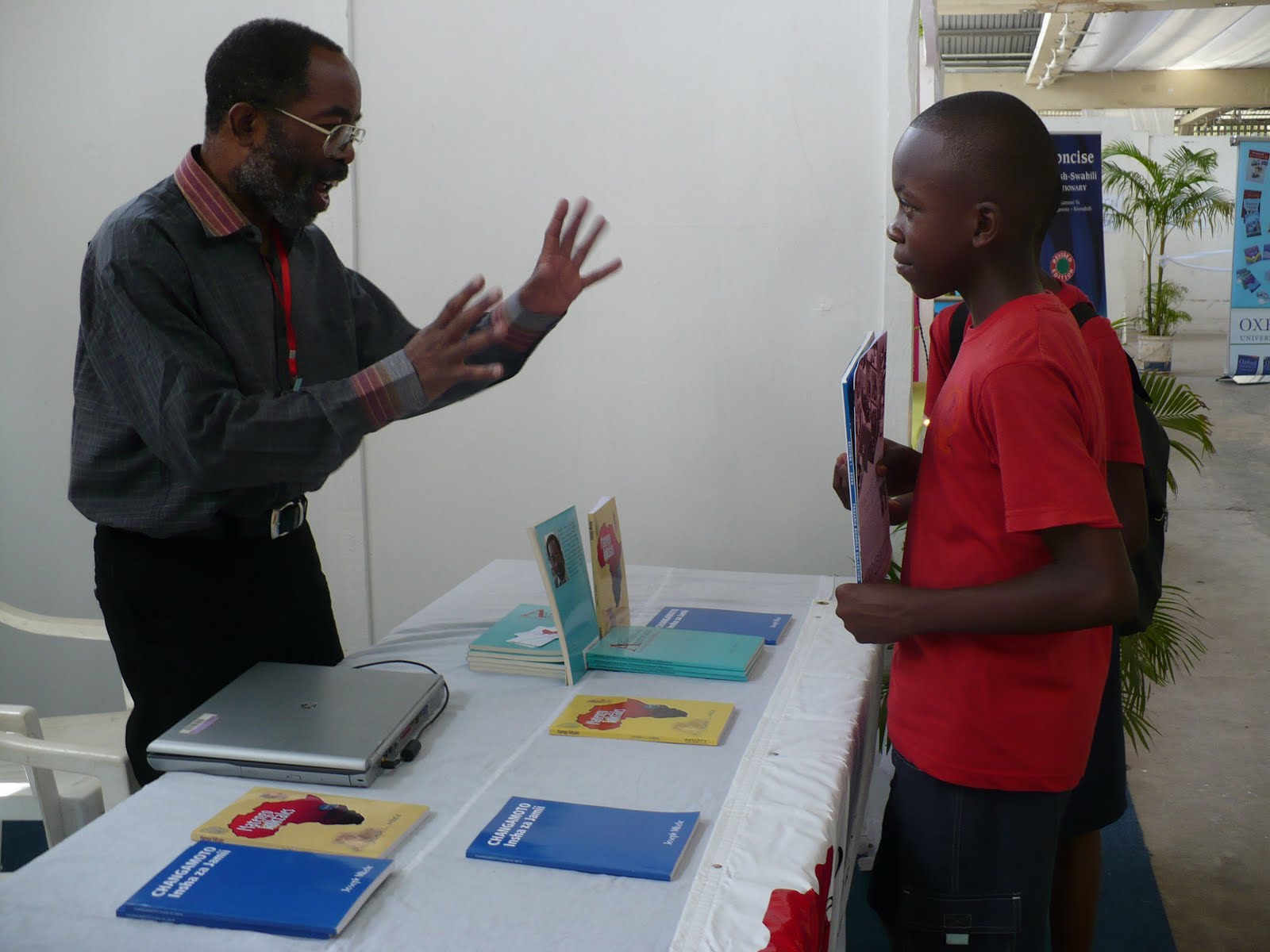
As I wrote in a previous blog post, on June 24-25, I participated in an educational and careers fair in Dar es Salaam, Tanzania, organized by Tripod Media. I sought, among other things, to introduce Africonexion, my small consulting business, to Tanzanians.


One of the most exciting experiences I had was observing the children who came to the exhibition. These were mostly school children. It was pleasant to watch them as they moved from booth to booth, alone, in pairs, or in groups. Like children everywhere, they openly displayed their excitement and curiosity. They made Diamond Jubilee Hall come alive.


The booth of the Tanzania House of Talents was a popular spot for the children, especially when the live music was on.


Those who came to my booth enjoyed browsing through my books. They were particularly interested in CHANGAMOTO, my Swahili book, since they could read it.


It was touching to see how genuinely interested these children were in books. I kept thinking why, as the children grow up and become adults, they lose this attachment to books. Our society is failing these children.


For the two days I participated in the exhibition, I talked with these children. I sought to inspire them, encouraging them to study hard. I told them to read widely, not just for the exams. They listened and I hope they will follow my advice.


One of the exhibitors was the Furniture Center. The children had a great time trying out the desks and chairs, pretending they were in a real classroom. When I saw this, I thought about the many schools in Tanzania which lack desks, chairs, books and other facilities. There is no valid reason for a country like Tanzania, rich as it is in resources, to have this problem.

The woman in a red head covering impressed me very much. She came with her son to the exhibition, and she asked me some questions. I wish all parents would do the same, accompanying their children to such educational events. It is good for the children and for the future of our country.

Monday, June 28, 2010

Workshop: Culture and Globalization, July 3

Venue: Arusha Community Church
Date: July 3, 2010: 9:00am-1:00pm
Presenter: Professor Joseph L. Mbele (St. Olaf College, USA)

Workshop Theme

The world is increasingly becoming a global village, with serious implications. What is globalization? What are the consequences of globalization? What is the global village? Will the global village be a pleasant place or a place of tension and suffering? What is our strategy for coping in the global village? Globalization brings both opportunities and challenges. What are these?

Within this broad framework, this workshop will focus on the cultural dimensions of globalization. In the global village, people of different cultures will have to interact, through living or working together. We will have to deal with people whose values, expectations, ways of thinking, acting and communicating are different from ours. Are we prepared for these challenges?

As we go abroad, to do business, to live, or just travel, we will encounter cultural differences. Even if we just stay in our own countries, we will deal with foreigners, whose cultures are different from ours. We need to understand these differences, in order to be effective in our dealings with foreign companies, business partners, volunteers, tourists, students, co-workers, and friends. How prepared are we when we embark on business ventures abroad? Without cultural literacy, can we conduct effective diplomacy?

As foreign companies, enterprises and organizations move into places like Africa, should they bring their values and ways of doing things to Africa, or should they adapt to the African ways? What are the pros and cons of either strategy? Some people talk about international standards. Are these international standards, or just European and American?

Such are the questions this workshop will address, building on Professor Mbele’s experience in conducting such workshops in the U.S.A. and Tanzania. His knowledge and experience will open new doors and new horizons. The workshop will be interactive, with participants freely asking questions and contributing their own perspectives. This strategy worked well in previous workshops, and this workshop should be even better.

Registration at the conference venue: Arusha Community Church
Fee: 20,000 shillings
Inquiries: info@africonexion.com
Phone: 0717 413 073

Friday, June 18, 2010

My Nebraska Readers

On June 9, 2010 I was in Amsterdam for several hours, on my way from Minneapolis to Dar es Salaam. As we were standing in the long, packed queue, proceeding to the boarding gate, a lady approached me confidently and asked me to sign a copy of my Africans and Americans book.

I did not know the lady, but she had the book in her hand. As she was handing me the pen and the book, I humbly asked for her name, and she told me to write Charlotte and Aimee. I asked where she was from and she said Nebraska, adding that she and several other people were on their way to Arusha, Tanzania, on a mission trip. Such mission trips are now very common among U.S. Lutherans and other Christians.

As Charlotte and I talked, we discovered that we have a mutual friend, Pastor Martin Russell, who is a seasoned leader of mission trips to Tanzania. I have never met him, but we are connected on Facebook. As we were getting connected on Facebook, Pastor Russell told me that he constantly recommends my book to mission trip participants. That is how Charlotte got to know about it.

During the flight, a young lady came to my seat and declared that she was Charlotte’s daughter and excitedly started praising my book, saying it “really nailed it.” Other people sitting nearby heard her. I was humbled. She asked if I would pose for a photo with her group later, and I gladly agreed.

When the plane landed at the Kilimanjaro International Airport in Arusha, I joined the group in the back of the plane and Charlotte took the photo shown here.


Such encounters with my readers have become quite common during flights between the USA and Tanzania. I am easy to recognize because of the photo on the back of my book, and I know that wherever I go, I cannot hide.

Friday, April 30, 2010

Writing About My Country

For about two weeks now, the idea of writing about my country has been foremost in my mind. How did it all start?

Certainly, Lonely Planet has something to do with it. I have been thinking about Lonely Planet perhaps more than at any time in the past, how its writers bring the remotest corners of the world into our lives. Lonely Planet has seen places I have not seen, and might never see, even in my own country.

Before Lonely Planet, however, there was Ernest Hemingway, one of the most gifted writers of all time. For me as an African, Hemingway is precious. His Green Hills of Africa described my country in ways hard to match, let alone surpass. His description of the land, the people, and the animals rings true on every page, as I noted in a previous post. He wrought the same magic, if not more, in his other African stories, including Under Kilimanjaro, published post-humously.

The desire to write about my country owes much also to Derek Walcott, the celebrated Caribbean poet and playwright, a Nobel Laureate like Hemingway, whose works I have read and taught for a number of years. These last two weeks, my thoughts have dwelt on Walcott squarely. What he says concerning his decision to write about his country is unforgettable. Growing up reading English poets, who celebrated, nay sanctified, their native land and its vegetation, such as the oak and the elm trees, the roses and the daffodils, he believed that English trees and flowers were the only ones worth writing about in poems.

He underwent a conversion later, wondering why the coconut and mango trees of his native Caribbean were deemed inferior to the elm and apple trees of England. He decided to strike in this new direction, writing about the coconut and mango trees, sanctifying them through poetry. In his poems and plays, he writes about his people: the fishermen, the fruit vendors, the workers in the tourist resorts. He brings the Caribbean to life, its complexity of colours and shapes, its ups and downs, its pains and hopes.

I think about my village and my home region, up in the mountains east of Lake Nyasa, and I think about Tanzania, my country. The dream of writing about it looms large on the horizon. I am not a poet, but working hard, I should manage to write some decent prose.

Wednesday, January 27, 2010

My First Book in Swahili

The year 2009 will remain special in my life as a writer. I published my first book in Swahili, a collection of articles I wrote for a Tanzanian weekly newspaper.


I accepted the invitation to write these articles with some trepidation, even though I found the challenge alluring. I did not have the experience of sustained writing in Swahili. I knew that I had to discipline myself and write in formal Swahili, devoid of code switching.

To sharpen my Swahili and build my confidence, I read the writings of Shaaban Robert, the doyen of Swahili writing in our era. I read his Maisha Yangu na Baada ya Miaka Hamsini, Adili na Nduguze, and Kusadikika, all available from Mkuki na Nyota Publishers.

The choice of topics was entirely mine. I wrote about political, economic, educational and cultural issues pertaining to Tanzania, with constant references to the differences between Tanzanian and American realities.

Now Changamoto is out, in both printed and e-book formats. To call it a labour of love would be somewhat disingenuous and an understatement. Semantics aside, the experience of writing has been both purgatorial and humbling.

I rarely read my own publications. I prefer to be writing something else. However, even though this little book is far more modest than my other writings, I return to it again and again, reading parts of it, hearing my own voice, still wondering how I managed to write a book in Swahili.

Tuesday, January 5, 2010

Cultural orientation for Gustavus Adolphus students

Today, I met with students from Gustavus Adolphus College, as part of their orientation for an up-coming study trip to Tanzania. They have been reading my Africans and Americans book, and I was happy to be with them, for over two hours, sharing my views and answering their questions.

I had talked with students from Gustavus Adolphus College before, as I reported here. It is always pleasant to be with people like these students, whose desire to learn and broaden their horizons inspires them to go to the remotest corners of the world. What place on earth could be farther away from Gustavus Adolphus College, Minnesota, than the village of Tungamalenga, in Tanzania's Iringa region? Tungamalenga was exactly where these students were going, alongside several other places in Tanzania.
Like last year, my preliminary remarks dwelt on what I consider the greatest challenge we all face when we visit or live in a foreign culture: to see and understand the other culture on its own terms.
As I looked around the room, I saw only excitement on the students' faces, and positive anticipation. There were copies of my book all around the room, and it was humbling to know that people are actually paying attention to what I wrote and want to know more.
Above, first on the left, is Professor Barbara Zust, who invited me to speak with this group, just as she did last year. Next to her is a relative of hers.
It was a very cold day in Minnesota, but we had had a wide-ranging and heartwarming conversation. Now it was time for the travelers to go back inside and conclude their orientation and get ready for the long flight to Tanzania.